


It was time to change the fork oil in the R100GS. This is an old bike now so needs the odd bit of maintenance but BMW made a lot of things very easy to do on these.
There’s a drain plug in the bottom of the forks legs so draining the oil is as simple as undoing those.
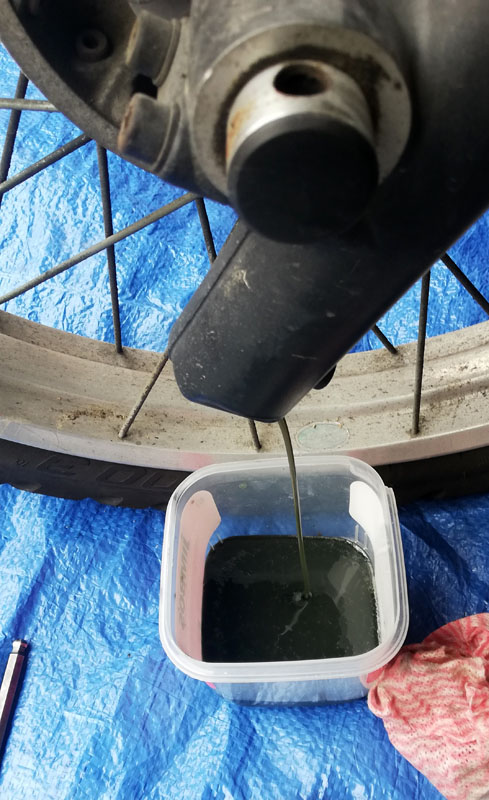
I drained 520ml from the left leg and 450ml from the right leg which was interesting as the expected amounts were 410mm in the left fork and 440mm in the right one so that’s what I put back in.
The front suspension is a bit unusual on these bikes as the one fork leg only does rebound damping and the other leg only does compression damping, though figuring out which one does which isn’t easy as several websites which are usually considered ‘authoritive’ give conflicting advice.
At present I’m working on the premise that the brake disc side which is the right side as you sit on the bike doing compression and the left side doing rebound.
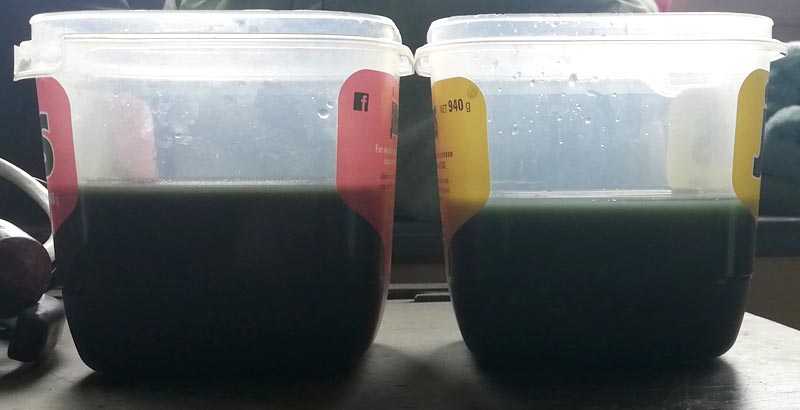
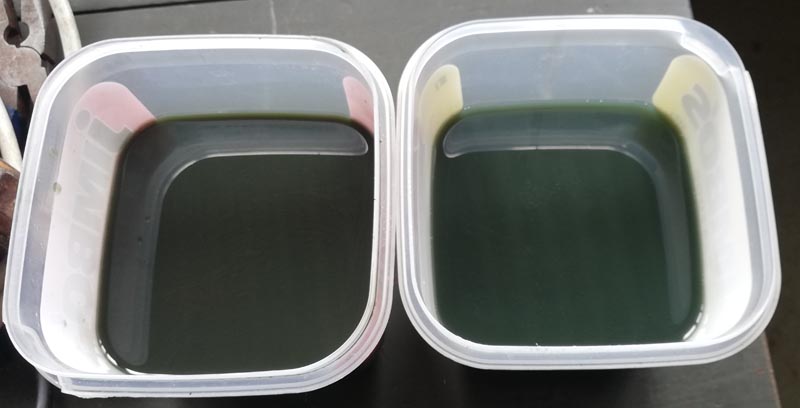
This doesn’t fairly show how crap the oil looked, the left leg in particular was more black than green
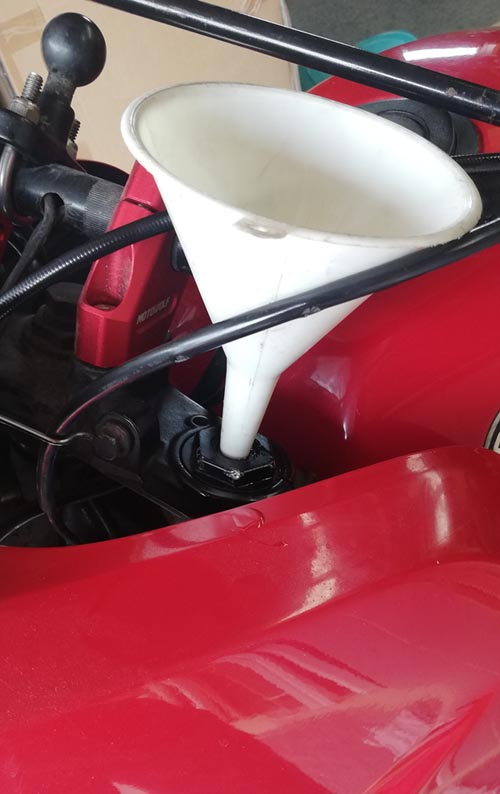
Refilling the forks is just as easy as BMW provide a filler bolt in the fork cap, just remove the bolt and pour the fork oil in.





Well the fork action is a little better, but not much, so I added another 20ml to each side so there’s now 430mm in the left fork and 460mm in the right one.
Overlooking Te Puke on the test ride.
Adding the extra 20ml made a good difference, so I’ve added another 20mp to each side.
Now 450mm in the left fork leg and 480mm in the right leg.
Adding the extra oil has improved things but still not right, no another 10ml in each side today bringing things to 460mm in the left fork and 490mm in the right one.
Overlooking Lake Rotorua on the test ride.
10ml was a bit too much so I’ve taken 5ml out again.
455ml in the left leg, 485ml in the right.
For my own records the fork oil was replaced at 68,300 miles
I also did the diff oil at 68,500 miles.
I realised I’d not been thinking about this properly, even though I commented in the first post that one side only does compression and the other side only rebound, so that adding oil to both legs at the same time was stupid, as I wanted more compression damping but rebound was getting pretty harsh.
So I’ve taken 40ml back out of the left fork leg only to hopefully soften up the rebound. We shall see what it actually feels like.
There should be about 415ml in the left leg and 485ml in the right one now. With such a difference it might illuminate which leg is really doing what.
As with most things on a airhead GS it’s very quick and easy to add and remove fork oil, it only takes a few minutes each time.
Taking 40ml out of the left leg highlighted that actually the left leg is doing compression and the right is rebound.
So 40ml out of the right leg and 40ml back into the left leg makes 455ml in the left and 445ml in the right.
More fiddling means 465ml in the left and 415ml in the right.
I’ve taken more out of the right leg, it’s now down to 385ml. I took 20 ml out and that made a big difference, so took another 5 for another improvement, and 5 again today, I think it’s pretty close.
435ml in the left leg, 410 in the right.
So I got pi**ed off with playing with the 15w, even though it was recommended by many online as being the weight to go for for an airhead GS.
I’ve drained both forks and replaced the fluid with the factory recommended amounts of 10w Silkoline and it’s better already. I’ve only ridden to work and back so far but it’s noticeably more compliant.
Wow! There’s a lot going on here that you seem a bit confused about. When i next sit down at my computer (couple of days away) I’ll put up a helpful response…too much to type on the phone.
Yeah fork tuning is part black magic part voodoo for me. I get the general theory but the implementation not so much, along with conflicting info on the net hasn’t helped, particularly with what fork leg does what on this particular bike .
I stumbled across an interesting reference tonight while searching for info on something else.
On this page: http://www.gunsmoke.com/motorcycling/r100gs/progressive_springs/index.html the owner is discussing how his bike came with the same fork springs mine did, and was experiencing exactly what I’ve been trying to remedy.
“Only problem was the bike came with Works Performance springs, which didn’t provide much compliance, resulting in a rough ride.”
In the end they ended up swapping the Works Performance Progressive Springs for a set of factory ones.
Ok, first comment: you are swapping units between mL (volume of oil put in to each leg) and mm (height of air gap with forks fully compressed, springs out). The former is used as an approximation of the latter. This sets the volume of air, which is the highly progressive air spring. It should be the same in each leg. It has little effect at full extension, tends to influence mid-stroke support vs compliance, and bottom-out resistance. There’s a limit to how small you can go as you must avoid hydraulic locking near full compression. Too little, and the inner workings won’t be fully immersed in oil at all times, creating all sorts of funkiness with cavitation, sucking air etc etc. You will notice I have not mentioned damping AT ALL. To tune with this, you add/subtract equal amounts of oil from both legs.
Second point: oil weight. SAE engine oil ratings such as 15W are really, really crappy for discussing hydraulic systems. Instead, use the centistokes (cSt) rating. SAE weights between oil brands (and between product lines within a brand) can be very random. Get these numbers by web search, reading the bottles, or the manufacturers’ data from their web sites. An example where this is a gotcha is KTM/WP’s preferred supplier Motorex specifies “4W” for many modern forks. Sounds light until you look at the cSt rating which for Motorex is about one SAE rating thicker. i.e. Motorex 4 = most others 5. Motorex 5 = many others 7.5. etc etc.
So, in order to tune with this, you need to compare cSt ratings of FRESH oil. If you wear out your 10W, and replace it with fresh 15W, you’ve effectively gone from 10 acting like 5 (or less) to 15. Probably all you needed to do was use fresh 10W. Fork oil only lasts 8-12,000 km in my experience. If a particular SAE grade is too thick or too thin, try another brand of the same SAE grade with a subtly different cSt rating. Or choose by cSt across all brands/weights.
Because this particular fork has separate damping functions, you can use the same volume of different cSt oils in each leg to tune the functions independently. Note also that having separate functions may not be 100% separate – it may just be a bias with one doing more of one thing than the other. That may make it harder to determine which does which.
[As an aside, it’s a very human flaw to want to “upgrade” a worn-out OEM component with a “better” aftermarket item, rather than simply do a like-for-like back to fully operational OEM spec part. ]
As to other people’s recommendations: firstly, refer to comments about SAE weights not being terribly useful. What cSt did they have, and what did they go to? What do you have, and what did you go to? There’s 4 numbers that may not be what you expect at first glance.
Secondly, where in the world are they? Talk to any NZ suspension tuner and they will tell you NZ conditions are different. People elsewhere around the world have smoother roads, often higher speeds and to a lesser extent higher loads – so they want firmer damping: less compliance, more support. Although “a bump is a bump”, in NZ we have a higher rate of big squarer-edged bumps, so the suspension has to act a lot faster more often than elsewhere. We need more compliance than support, comparatively speaking. That’s the dark art stuff, and why suspension doesn’t work ideally for everyone everywhere, and has to be custom tuned.
Another note: oil weight and air chamber size are related. Generally, if you increase the oil thickness, you should also reduce the oil height (increase the air chamber) and vice versa. That’s because the higher damping will reduce the fork’s tendency to compress into the mid and full travel, and you want to maintain the compliance.
The springs are interesting. Those springs made by “Progressive” appear to be dual-rate, not progressively wound. Both types are flawed vs the correct straight rate spring. Dual rates swap from (too) soft to (too?) hard when the softer rate coil-binds. This is not nice when you are tipping in to a corner and want maximum traction and feel. Progressive springs are only at the correct rate at one point in their travel. The best argument for progressives is for bikes used solo and pillion.
Question: why would you need a progressive wound steel spring since every fork has a tunable (very cheaply via oil height) progressive air spring???
Soft springs can be too harsh (a la my OEM 640 Adventure fork) as the bike sits too far into the travel at rider sag, unless you preload too much. But regardless, without sufficient support it also travels too far into the stroke too fast (spring is position sensitive based on the rate vs load), spiking the velocity-sensitive damping. Going up one rate from OEM 4.6 N/mm to 4.8 N/mm transformed my bike, made the front end both more plush and more supported (less dive).
Fascinating! Found a fork oil viscosity comparison chart that states the following for two, 5W oils:
Silkolene Pro 5 wt: 27 cSt
Honda HP Showa/Kayaba Fork Oil 5W: 15.06 cSt
Conclusion: Follow bikemoto’s advice and check true viscosity of any oil you are contemplating
@bikemoto I’ve had a couple of bikes come with progressive springs and never liked them due to only being able to get damping right at one point but these ones seem worse than most, I cant get it bearable at any point.
I’m going to put the word out to see if I can find even some stock straight rate springs, almost anything would be better than these, but I’m not in a situation where I can splash out on a full rebuild at present. Ideally I’d go a bit harder that stock which is documented as .47 and a properly installed gold valve. I’ve had a GS the same vintage in the past and the stock springs were a quite a bit too soft on medium-high spring speed hits, plus I’m about 15kg heavier than I was when I owned the last one, though my riding is also more tame.
Thanks for the bit about cst ratings, I usually try to stay within brand when swapping oils around to get at least some consistency but I couldn’t get any Motul over the Christmas break as most shops were closed. For the stock forks on these a heavier weight in the right fork than the left is popular.