


View and Sign the petition on Change.org
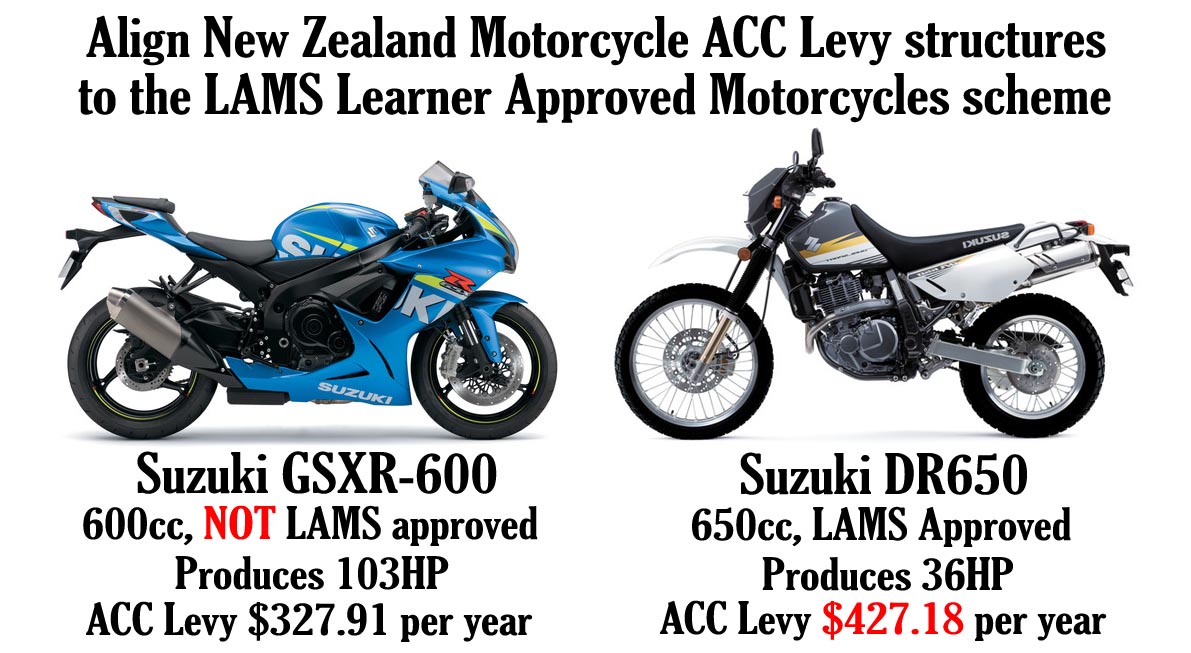
New Zealand’s current motorcycle ACC motorcycle levy structure and the LAMS learner approved motorcycle scheme are in conflict in relation to how the current motorcycle ACC fee is applied to learner approved motorcycles versus more powerful motorcycles that have a greater cost risk to ACC.
The NZTA LAMS Learner Approved Motorcycles defines a list of motorcycles deemed to be of low enough power that they are suitable for learner/new riders as below (1):
The NZTA LAMS learner license scheme defines LAMS leaner approved motorcycles as:
- All motorcycles with engine capacities of 250cc and under, except for those on the LAMS-prohibited list.
- Fully electric powered motorcycles with a power-to-weight ratio of 150 kilowatts per tonne and under (this includes all fully electric powered motorcycles registered on New Zealand’s Motor Vehicle Register as of 1 June 2012).
- All motorcycles manufactured prior to 1960 with an engine capacity of 660cc and under.
- The following list of motorcycles with engine capacities between 251cc and 660cc – these motorcycles must be in standard form as produced by the manufacturer. They cannot be modified in any way to increase the power-to-weight ratio. (See the list of approved motorcycles: http://www.nzta.govt.nz/ licence/getting/motorcycles/ lams.html#approved).
The ACC Levy is applied to the registration fee for all motorcycles, with motorcycles over 600cc (601cc+) paying a premium of $99.27 over motorcycles of 600cc or less.
ACC’s justification for this is “more powerful bikes have a greater cost risk.”(2)
Current ACC Motorcycle Levy Component of registration fees (3)
Motorcycles up to 600cc $327.91
Motorcycles 601cc + $427.18
This leads to a conflict where 24% (85) out of the 352 different makes and models of motorcycles engine capacities from 601cc and 660cc, yet defined by the NZTA as being low powered enough to be learner safe and listed on the LAMS learner approved motorcycles list are considered by ACC to be “More powerful motorcycles” and charged the significantly higher ACC levy rate. This is a significant proportion of the LAMS approved motorcycles with engine capacities from 601cc and 660cc.
All of the 85 makes and models of motorcycle that are LAMS approved yet have an engine capacity of 601cc to 660cc produce 50% or less of the power than many motorcycles rated at 600cc and therefore receiving the lower ACC levy do, for example the Suzuki GSXR-600, Yamaha R6, Honda CBR600 and others all produce double the power or more of the LAMS approved models of 601cc to 660cc. This goes directly against ACC’s claim that motorcycles over 600cc are more powerful so have a greater cost risk.”(2)
This punishes a large number of existing motorcycle riders who ride lower powered motorcycles with engine capacities from 601cc and 660cc which are still Lams approved, and provides a strong dis-incentive for learners riders to purchase the impacted makes and models of motorcycles, thus narrowing their choices.
Data Sources:
(1) http://www.nzta.govt.nz/ vehicle/registration- licensing/fees.html
(2) http://www.beehive.govt.nz/ sites/all/files/ACC_ QuestionsandAnswers.pdf
(3) http://www.acc.co.nz/for- individuals/motorcyclists/ index.htm#P34_2384
We the undersigned call for the ACC Motorcycle Levy structure to be aligned with the NZTA LAMS leaner motorcycle scheme by either
A) Changing the “Motorcycles up to 600cc” category of the ACC levy to “Motorcycles up to 600cc or LAMS approved”
or
B) Raising the CC changeover point of the ACC motorcycle levy from 601cc to 661cc






Done
this is another reason I don’t get a bigger bike than me XT600 eh’ the ACC is high enough on that!!!! the thing that reallii get’s me is I have 4 vehicles I can onlii use one at a time so why do I have to pay ACC on all 4??!?? it makes no sense to me…………………..p.s I onlii register 1 of each by the way
322 people have signed as of this afternoon.
I’ve shared the petition on Facebook to KiwRider and Motorcycle Trader magazines, along with the New Zealand Motorcycle Riders group. does anyone have any ideas of where else I can share it?
Eddie
done! didn’t even know about the inconsistency.
done
Would the new ACC levy rating system for light passenger vehicles be a good thing for motorcycles? at face value it seems it to me.
Information on the new ACC levy rating system for light passenger vehicles can be found on the ACC website at: http://www.acc.co.nz/for-individuals/other-motorists/WPC137732
The specific information on how much the new ACC levy for your car will be if it has been specifically rated is in a pdf at: http://www.acc.co.nz/PRD_EXT_CSMP/groups/external_levies/documents/reference_tools/wpc137747.pdf
For some reason diesel vehicles have a much higher acc levy under the new system:
For example the Suzuki Escudo/Grand Vitara manufactured after 2002
My 2.7 litre petrol version has an ACC levy of $103.46
@michael_j_breen’s 1.9 litre diesel version has an ACC levy of $186.13.
Apart from the engine they are the same vehicle, even down to the colour.
Bumped for our newer members to see this.
Signed.
500th signature!